
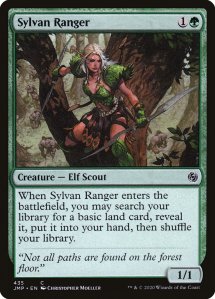
I think it’s easy to look at Sylvan Ranger and very quickly key into what this card does not do and draw some unfavorable comparisons. In fact, it is a much stronger role player than most folks recognize but suffers from being drawn into conversations where it really doesn’t belong.
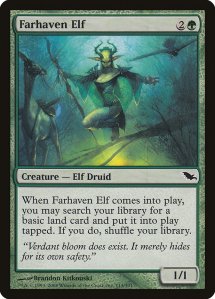
One of the common ways that this card is misevaluated is by comparing it to cards like Farhaven Elf, which appear to occupy a similar space. They actually serve two distinct, complementary purposes. With Farhaven Elf, the language of putting a land from your library directly onto the battlefield tapped reads explicitly as mana acceleration, whereas Sylvan Ranger affects things much more implicitly. We can, with very few exceptions, only really accelerate our mana when we are able to also play our lands every turn. Farhaven Elf does not actually provide extra resources unless we are hitting our land drops; otherwise, we are simply spending three mana to keep pace. Rather than framing Sylvan Ranger as a competitor or alternative to traditional acceleration effects, it more accurately exists as a complement and should be seen as something additive to an existing mana acceleration package. It is also worth mentioning that in relation to Farhaven Elf et al, Sylvan Ranger is generally more effective in a mid to late game scenario where we may not have lands in our hand to play every turn. In a context where we would otherwise miss a land drop, being able to play the land from our hand untapped, versus putting it directly onto the battlefield tapped, is simply a cleaner play pattern.
This is a dynamic that really comes through in decks that are able to recycle these cards and repeatedly utilize their triggers. The flexibility in having both a Sylvan Ranger and a Farhaven Elf in concert with one another really goes a long way to ensure that you are, actually, developing your resources appropriately turn after turn. The flexibility to reuse a Farhaven Elf if we are naturally drawing into lands, versus Sylvan Ranger if we are not, should demonstrate the differing strengths of these effects and the interplay between them.
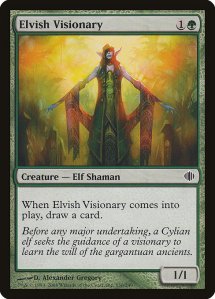
A feature that probably flies under the radar a bit is the fact that Sylvan Ranger occupies a really great space on the mana curve. When it comes to creatures that generate card advantage, three mana seems to be the place where things start to get really congested. Having ways to get things rolling at earlier points on the curve helps smooth out the early turns, where land drops are more integral to setting the pace of the game. If we’re looking to play on curve, Sylvan Ranger will oftentimes be a more significant early play than a card like Elvish Visionary or Dusk Legion Zealot. All three of these cards replace themselves, but only Sylvan Ranger will always replace itself with a significant early game resource.
The broader perception around this card seems to center on the idea that it isn’t exactly card advantage, and it doesn’t exactly ramp, but it actually very cleanly does both of those things, just not in a way that is the easiest to grok. It’s just a great example of a card that plays a lot better than it reads.
 commander, dear reader