
For as long as there have been Commander players, there have been, in one form or another, Pauper Commander players. No one knows for sure who first uttered the words, “I will build my Elder Dragon Highlander deck with only common cards,” but the idea has, over the years, taken root in the Magic forums of old and grown into what is now a format unto itself.
As the community for Pauper Commander continues to steadily expand and the format garners more attention across various Magic community spaces, I wanted to put together something of a primer. I haven’t written extensively about Pauper Commander in several years now, and it seems fitting that my return to the topic is in service of bringing it to a larger audience. I don’t want to focus exclusively on what the format is, but more so on why it’s worth playing. The few times in years past that Pauper Commander has been featured by larger, more mainstream content creators, it’s been translated in a pretty unflattering way that I feel doesn’t do justice to how approachable, engaging, and enjoyable it really is.
First, before I start waxing too pedantic, let’s set the stage with some cold, hard facts for the uninitiated. Pauper Commander is a variant of the Commander format; the rules are largely the same, with a few key differences:
- Your commander may be any uncommon creature, legendary or otherwise.
- All cards in the 99 must have been printed/released at common rarity either on MTGO or in paper – essentially utilizing the Pauper format card pool.
- Players begin the game with 30 life.
- A player is eliminated if they take at least 16 combat damage from a single commander.
Additionally, there are only two cards banned as of this writing: Mystic Remora and Rhystic Study. You can read a little about why here.
Pauper Commander isn’t simply a “less powerful” version of Commander; it has a rhythm all its own. While the core framework of the game play is largely congruent with Commander, the way that narratives are constructed and play out is markedly different. It’s a format for those who have an affinity for casual, multiplayer, singleton Magic, but also an interest in the simpler side of function and an under-served segment of the card pool. Essentially, Pauper Commander may be for you if:
- You believe whole-heartedly that restrictions breed creativity.
- You enjoy simple card designs with functional applications.
- You like going deep and exploring the card pool.
- You find limited formats, like draft and sealed, enjoyable.
- You prefer interactive games of Magic.
- You think that Spiritmonger would make a sweet commander.
Allow me to elaborate.
The old adage that restrictions breed creativity is front and center in Pauper Commander. Only having access to commons in the 99 of our deck forces us to re-contextualize cards that we may have never seen as more than draft chaff. In Pauper Commander, draft chaff is king! Reflect for a moment on how many different cards there are at common with the rules text “counter target spell.” Each of these variations, with their different riders and conditions, printed set after set, actually starts to become relevant in Pauper Commander, providing different textural elements that elevate the basic structure of the card to something that actually matters and can lend a deck identity. You Find the Villains Lair and Urza’s Rebuff are perfect examples of this – what are otherwise simple variations on a theme find specific homes in specific decks that can appreciate their specific modalities.
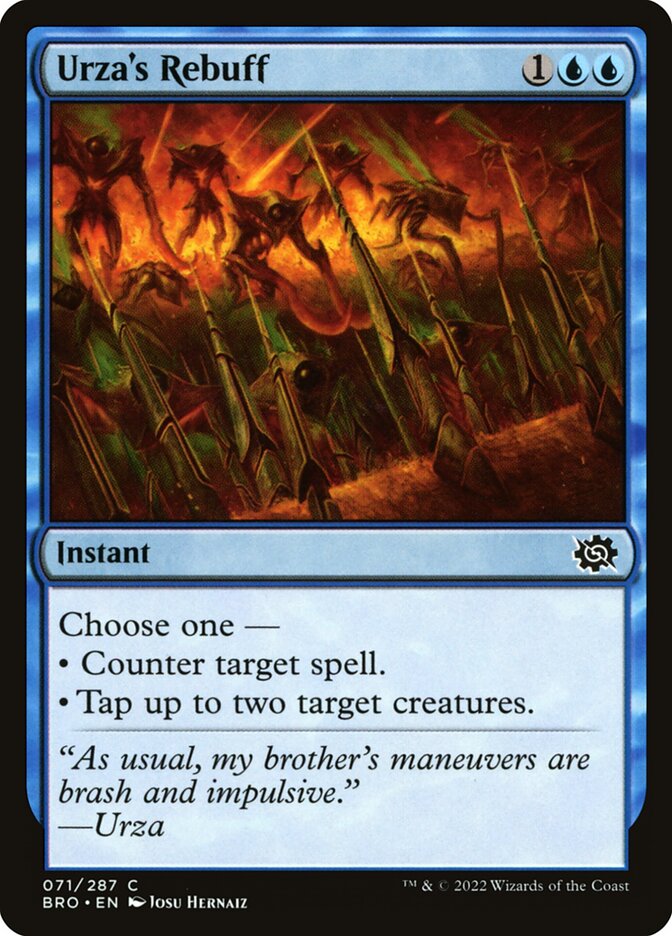
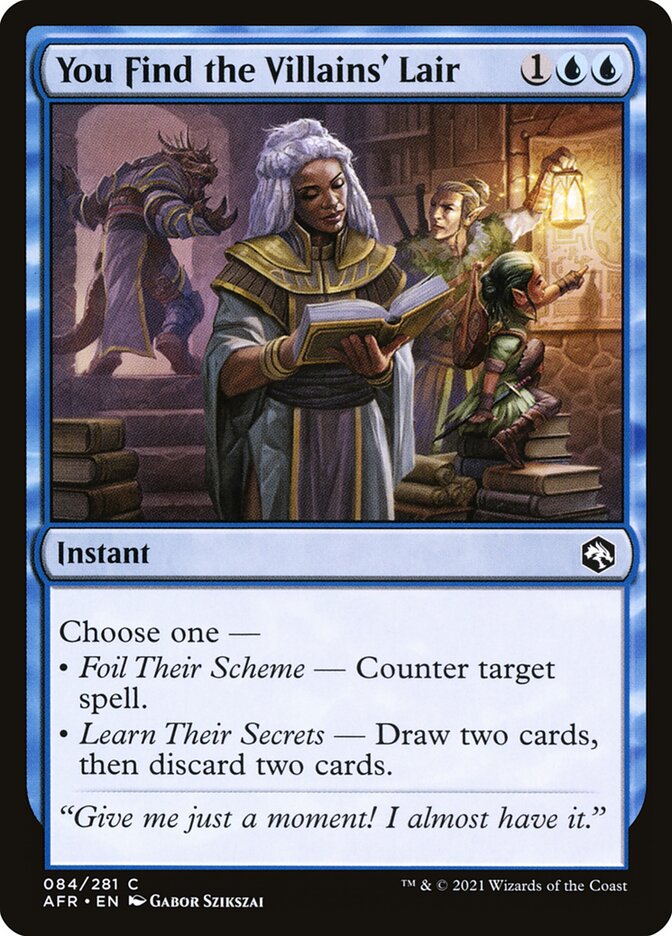
This is a paradigm that holds true across many different effects that have existed at common for decades – red burn spells, green fight/pump spells, black removal spells, white protection spells, and so on. One of the things that makes Pauper Commander so interesting is that from deck to deck, different iterations will be preferable to others, and the breadth of cards that see play under this framework is truly astounding. The little things start to matter more as resources become more valuable.
I think that Commander, in general, has gotten a little lost in the sauce recently. Over time, it’s become a space where resources seem to matter less and less – it’s pretty trivial to generate tremendous amounts of game objects, mana, cards-in-hand, etc. When these kinds of things become arbitrary, it tends to follow that the in-game decisions regarding them become increasingly arbitrary as well, and I think that overall game play suffers a bit for it. Pauper Commander effectively skirts this issue, since those most powerful resource-generating effects in Commander are simply not part of the available card pool. As a result, we get a format that retains all of the perks of a multiplayer singleton format, but with a much more nuts-and-bolts orientation that feels a lot like an intersection of Commander and limited Magic. While there is definitely a focus on smaller, functional effects due to the nature of the card pool, those big Commander moments still occur – they just don’t drive the narrative as comprehensively and the games tend to have a lot more story beats.
What does drive the narrative significantly in Pauper Commander, however, is the choice of commander. The freedom to choose any uncommon creature to put in the command zone goes a long way to set the tone of a game. The power level delta between commons and uncommons is wide enough to where strategies and game play revolve more closely around commanders. Very rarely in Pauper Commander does it make sense to choose your commander purely on the basis of color identity; not having a commander that contributes meaningfully to the end-goal of a deck is a much larger liability.
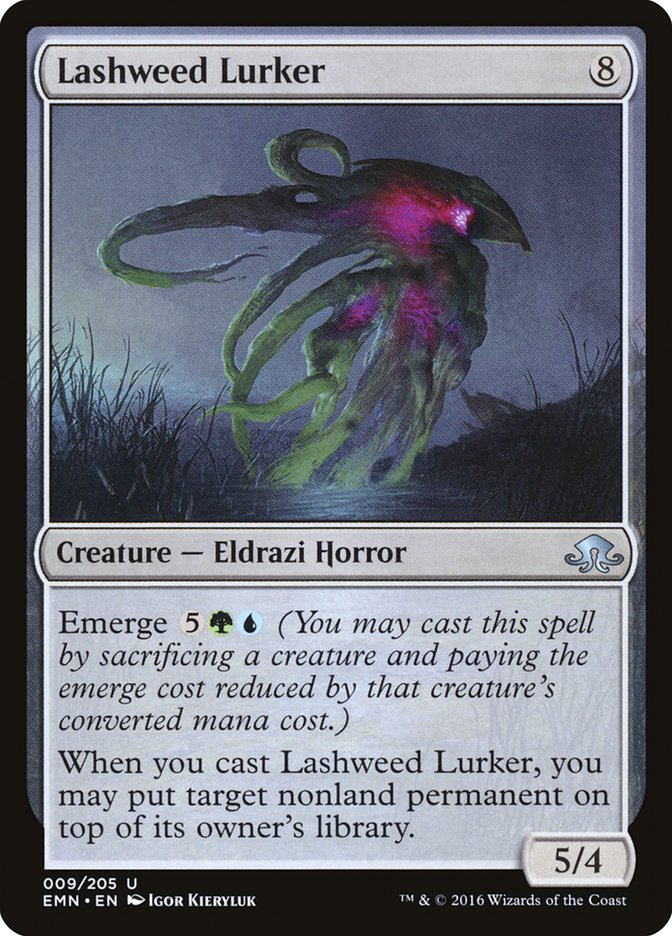
Additionally, in regards to available commander options, the breadth of uncommon creatures out there enables a lot of strategies that may not be well represented elsewhere, and there are many creatures that showcase various set mechanics that don’t translate into an analogous Legendary creature. Take Lashweed Lurker, for example. There is no emerge-themed Legendary creature for Commander (which is wild because it’s such a sweet mechanic), but Lashweed Lurker can fill that role in Pauper Commander, opening up a novel deck building space that is pretty unique unto itself. It is by no means alone in this regard.
Now, at this point, you may be asking yourself something along the lines of “…But how do I get started?” It’s always kind of overwhelming when getting into a new format, despite how close it may seem to something you’re already familiar with.
I think a great way to get one’s feet wet is to become familiar with the broader community spaces and resources out there. For the more casually-inclined, the first stop I’d recommend is the PDH Home Base. These are the folks that took stewardship of the format, codified the current rules, and now make up a chunk of its governing body/rules committee (myself among them). In addition to having a pretty deep well of articles written over the past five years or so, along with the official rules and FAQ, it also contains a link to its discord server, which is probably the single most active Pauper Commander community out there. It’s mostly oriented towards the casual end of the format, but does have channels geared towards more competitive play that see a fair bit of traffic.
And if competitive play is more your speed, Pauper Commander does have a thriving competitive scene/metagame, similar to cEDH and its relationship with Commander. A great place to start is cpdh.guide, which has links to other competitive resources, along with a library of sample deck lists to get you started. Among the resources provided is a link to The Tryhards discord server, which is a buzzing community of competitive-minded folks who are really keen on throwing everything against the wall and seeing what sticks. This is a great collaborative place to dive into the competitive end of the format, which is still largely under-explored. Whether casual or competitive, Pauper Commander is certainly a brewer’s paradise.
There is also a lot of content out there to help ease the transition into the format and get a grasp on the basics. For the podcast lovers, The PDH Pod is fantastic for players new to the format and contains a lot of good information on how to engage with it in a positive way. They explore archetypes, do set reviews, and whatever other manner of engagement with the Pauper Commander ecosystem to serve as a good baseline of knowledge for someone looking to get involved. They also put out some recorded game play content as well on Youtube, pulled from twice-weekly streams on Twitch. The Common Connoisseurs Youtube channel is likewise home to a lot of competitive-leaning game play content in addition to deck techs and deck-building streams. This is a great resource to see what competitive Pauper Commander games can look like and provide good context as to what to expect. Overall, between these two sources of Pauper Commander content, any prospective player should be able to cover their bases and find something that enriches their experience with the format.
But hey, let’s say that you don’t care one little bit about content. Let’s say that you just want to build a deck and dive right in. By virtue of the fact that any uncommon creature can be your commander, there is a truly daunting number of potential commanders out there. Coming to the format cold, either from Commander or 60-card Pauper, the two-color uncommon creatures that exist in pretty much all standard sets nowadays (serving as signpost cards for limited formats) are great places to start. For example, in Brother’s War, there are ten two-color uncommon creatures that each are mechanically distinct, and, in the context of Pauper Commander, build out into ten unique decks. From there, it’s just about picking the one that lines up best with what you like to be doing in a game of Magic. Much like the commanders that are designed for Commander pre-constructed decks, these creatures go a long way to direct the initial experience and provide a foundation for further exploration and customization. Piloting a deck that has clear goals and focus will serve as a stable experience that can be leveraged into more nuanced and experimental deck building down the road.
AND SPEAKING OF PRE-CONSTRUCTED DECKS, I’ve put together a few basic introductory level “pre-constructed” deck lists here, led by a handful of the aforementioned Brother’s War commanders, to serve as a template of what a Pauper Commander deck might look like and a possible starting point for your own deck-building curiosities. Make them your own!
You can also see a handful of my personal Pauper Commander decks on Moxfield.
So those are all the big notes that I wanted to hit. Hopefully that all gives you an idea of what the format’s about and how it can be additive to your overall Magic experience. I firmly believe that when it comes to casual play, exposing yourself to different formats and restrictions will only enrich how you engage with the game holistically. For me, personally, going deep on Pauper Commander has only made me a better Commander player/deck builder, and vice versa. There’s no better way to level up your deck building and gameplay perspectives than to put yourself in an environment that forces you to recontextualize cards and situations in ways you never would have otherwise.
Let me know how it goes for you. Ask me whatever you want. I’m on Discord as derek#0704 and Twitter dot com @derekdearreader.
 commander, dear reader